A city of six months
Artists and architects gather in Shanghai, and the site becomes a collection of architectural treasures across both banks of the Huangpu.
Rebuilding the temporary city of Expo 2010 Shanghai, one source and one block at a time.

What survives when a city designed for six months disappears?

In 2010 I was a child who could not travel to Shanghai—so I toured the Expo on the internet instead.
The Expo closed after six months, and most pavilions were torn down. I was only a child then—I never got to see it, and that became the greatest sorrow of my childhood.
What I had instead was the online Expo: the first world exposition to put itself on the web, with Future City, a game that rebuilt the whole site in 3D and let you walk through it. That was the first time I understood that a real place could continue to exist as a navigable digital world.
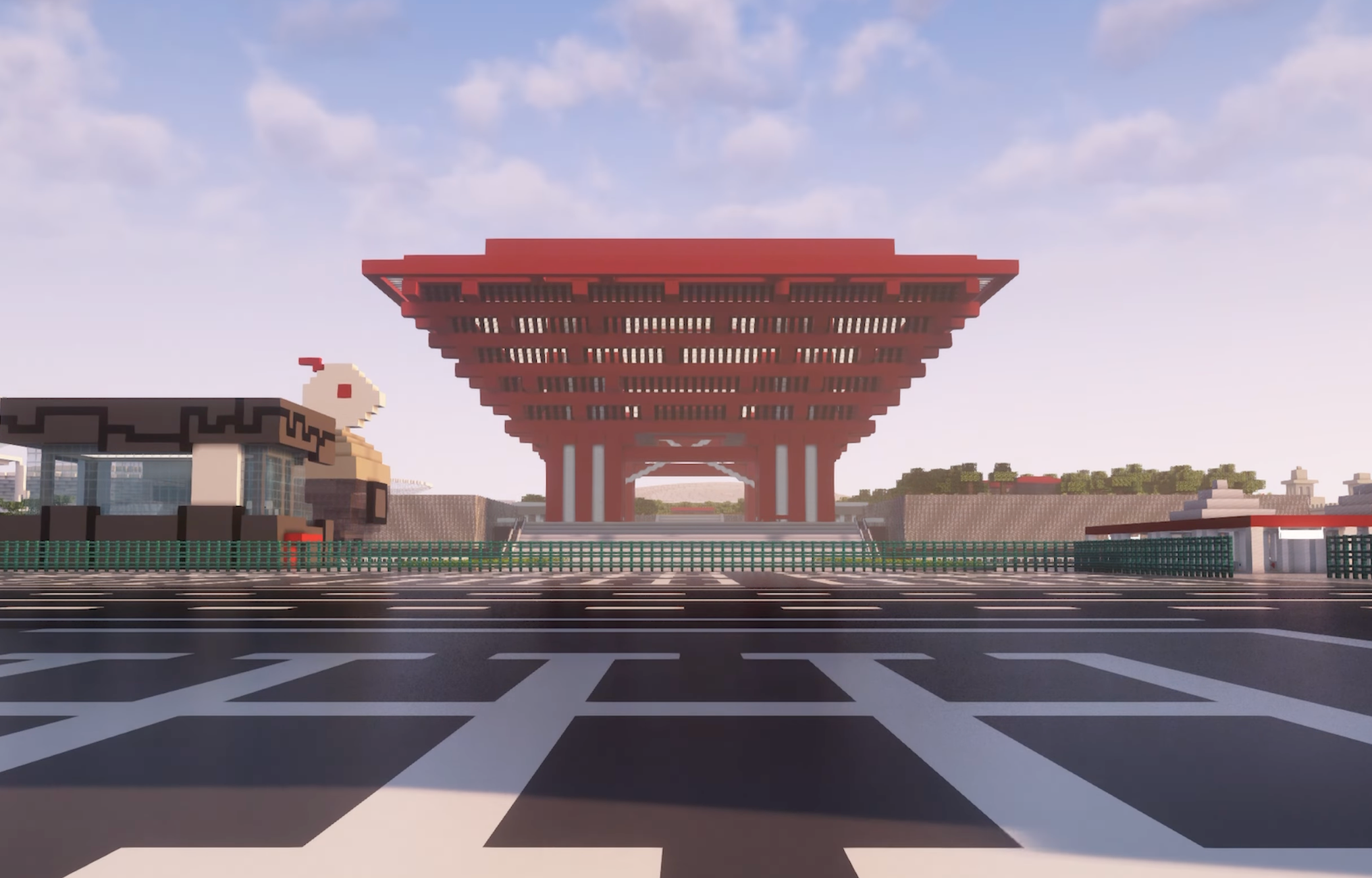
Since I first touched Minecraft in 2012 I have spent more than a decade building in it—Chinese traditional architecture and modern architecture alike. Now I decided to make the childhood dream come true: rebuild the 2010 Shanghai World Expo Park in the Minecraft world.
Artists and architects gather in Shanghai, and the site becomes a collection of architectural treasures across both banks of the Huangpu.
Future City rebuilds the whole site in 3D and lets you walk through it before the real park disappears.
When the Expo closes, most pavilions are dismantled and websites decay—photographs preserve buildings, but nobody preserves the whole.
In Minecraft the site is rebuilt block by block, every decision answering to a source—a place that can be walked again.
A world exposition is an archive built to vanish.
A world exposition is a large global exhibition that showcases the achievements of nations, held at a specific site for a limited period. Expo 2010 Shanghai—held on both banks of the Huangpu River from 1 May to 31 October 2010, under the theme "Better City, Better Life"—became the most participated and most visited world exposition in history.
An exhibition is a display which, whatever its title, has as its principal purpose the education of the public: it may exhibit the means at man's disposal for meeting the needs of civilization, or demonstrate the progress achieved in one or more branches of human endeavour, or show prospects for the future. 1928 Paris Convention, Article 1
And it was built to last six months. When it closed, buildings were dismantled and websites decayed—the official online exhibition on EXPO.CN was permanently shut down in June 2026. The complete spatial experience, the sequence of pavilions, distances and adjacencies, became harder and harder to recover. Photographs preserved individual buildings. Nobody preserved the whole.
The ambition began as a childhood wish; the discipline that followed is the real contribution. A reconstruction of a vanished place is a claim about what was there, and the only way to make that claim trustworthy is to make every block answer to a source.
Expo guides, yearbooks, pavilion descriptions, press material and planning documents.
Historical maps, sector plans, aerial photography, satellite imagery and coordinates.
Visitor photographs, construction images, broadcast footage and surviving web pages.
Existing buildings, post-Expo reuse, site visits and comparisons with the current city.
Fan archives, personal recollections and material scattered across discontinued platforms.
Internet Archive captures and mirrored pages used when original Expo resources disappear.
Location, footprint, orientation, surviving traces and terrain context.
Façade rhythm, openings, structural cues, colour, material and relative scale.
Intermediate geometric studies where direct block construction is inefficient.
Reference conversion before manual correction in Minecraft's block grammar.
The final reconstruction environment, navigable archive and shared building space.
Research the original park, restore its map and rebuild key buildings and public space inside Minecraft.
Spatial foundationContinue locating plans and images, revise proportions and complete sector-level ground and building information.
Iterative archiveDevelop interpretation, exploration and participatory building on top of the reconstructed scene.
Public experienceBuild the entire 2010 Shanghai Expo Park in Minecraft. Most of Sector A, the Expo Axis, the Expo Culture Center and the Theme Pavilion in Sector B are built to date.
Redesign and rebuild the exhibition content.
Design and develop games or interactive products based on the project.
Rebuild the representative buildings of past World Expos—EXPO 1970 and beyond.
The site map is more than navigation. It is the index that connects a building's coordinate, sector, country or function, evidence package, reconstruction status and revision history.
What survives is a walkable reconstruction—a coherent, navigable place that restores the relationships isolated photographs cannot show—plus a building catalogue, a learning environment, and a participatory project open to correction.
The honesty cuts both ways: a new photograph can correct a window; a recovered plan can move a whole façade. Completion is less important than keeping every reconstruction open to evidence.
ExpoCraft is a third-party project supported purely by personal interest. If you can provide relevant information or want to join the project team, get in touch through the ExpoCraft site. If you would like to support us financially—by sponsoring a cup of coffee—there is an AFDIAN page.