
My First Day at Twenty-Four Began in a Tokyo That Never Sleeps — Tokyo Travel Notes, May 2026
ContentsDay 0. Sunset Before a New Year of Life
This essay was originally written in Simplified Chinese. This English translation was produced by GPT-5.6 Sol.
These travel notes are simply what came back to me as I looked through my photographs: written as the memories surfaced, wandering wherever they happened to lead.
Day 0. Sunset Before a New Year of Life
I flew with Spring Airlines from Shanghai Pudong International Airport to Narita. As the plane was about to land, I looked out of the window. A sunset seen from the stratosphere—that was a first for me.
 Sunset over Chiba Prefecture, seen from the stratosphere
After landing, nothing could have done more to heal the torment of two and a half hours in economy class than a steaming bowl of rice topped with yuxiang shredded pork (a Sichuan dish whose name literally means “fish-fragrant,” though it contains no fish). The truth is that my palate has never quite adapted to Japanese food, so every time I visit Japan, I make a point of looking for Chinese cooking.
 Yuxiang shredded pork at a Sichuan restaurant
This Sichuan restaurant was in Asakusabashi, not far from where I was staying. By a curious stroke of timing, it was closing for a week from the 23rd—the day after this dinner—right through to the day I left. If I did not eat there that night, I would miss it altogether. With that thought in mind, I went in.
As for the yuxiang shredded pork: it was better than what I usually find in Shanghai, though still not as good as the version back home. The Hetao region around my hometown has its own way of making the dish, and that is the flavor I love. Anyone curious enough to search in Chinese can try “呼和浩特鱼香肉丝”—Hohhot-style yuxiang shredded pork.
The proprietress was a warm and attentive Chinese woman—though, to be fair, attentive service is the norm in Japan. The restaurant was cash only, however, and I had not yet had time to withdraw any yen. I offered to leave my ID with her while I went to a convenience store. She said there was no need: just go, she would wait for me. Although saying so risks getting me branded a gongzhi (a derisive label in Chinese online discourse for someone thought to praise foreign countries reflexively), I have to admit that a proprietor in China would probably not have trusted me simply to walk out.
Day 1. My First Day at Twenty-Four
It was my twenty-fourth birthday. That was also why I had chosen this particular time to come to Tokyo.
Akasaka Palace
Akasaka Palace is Japan’s only Baroque building, and perhaps the only place in East Asia where one can feel the opulence of a Western royal court. I had wanted to visit for a long time. Why put it first on my itinerary? From 24 to 31 May 2026, the palace would be closed for the state visit of Philippine president Ferdinand Marcos Jr. It is, after all, Japan’s State Guest House. That left this day as my only window.
 Akasaka Palace
 Akasaka Palace
 The Asahi-no-Ma room at Akasaka Palace
The interior is extravagance taken to its limit: unmistakably Baroque. Photography is forbidden inside, unfortunately, so I would have to rely on the exterior of this Western-style palace to summon the rooms from memory. I found an online photograph of one of them, Asahi-no-Ma, taken during a meeting between Donald Trump and Shinzō Abe. It gives some idea of the splendor within.
 A photograph in the forecourt of Akasaka Palace
Naturally, I wanted a photograph of myself at the palace. The south façade is even better suited to one than the north, since a great fountain stands at the center of its garden. Yet after asking one passerby after another, none of the results was quite right—or, less politely, most were unbearable. I care a great deal about how I look through a lens. At last, in the forecourt, I asked a young woman for help and finally got one I could live with. Young women really do tend to have a better eye for portraits.
By the time I came out, it was around lunchtime. Tables and chairs had been set out in the forecourt, with coffee and sweets available. What could be lovelier than eating there amid the aristocratic atmosphere of a Baroque palace? Unfortunately, every seat had been reserved. I had to go outside instead. Beneath the main entrance is a purpose-built underground rest area that also serves drinks and light meals, so I made do with a simple lunch there.
 A cup of hōjicha, an apple pie, and a small bowl of ice cream
The Marunouchi Building of Tokyo Station
This building deserves a proper digression. In prewar Japan—and further back, in the Meiji and Taishō eras, after the Restoration had begun but before the country became so fevered that the words “Anglo-American beasts” could trigger a reflex—Japan was steeped in the mood of “leaving Asia and entering Europe.” To embrace Western civilization wholesale was to become “civilized and enlightened.” In an age when every gaze turned toward Europe and America, Western-style buildings sprang up across the center of imperial Tokyo like mushrooms after rain.
In the early Meiji years, these were still pseudo-Western structures: buildings that borrowed a few Western motifs while remaining neither quite Japanese nor quite foreign. Then Japanese architects trained by Western masters returned home, and more orthodox Western architecture began to spread, especially through Tokyo. Marunouchi, where the station’s main building stands, became one of the greatest concentrations of these buildings. In the Meiji and Taishō periods, its red-brick cityscape was likened to London and nicknamed “Icchō London”—London for a block. In the Shōwa era, the arrival of New York-style skyscrapers earned it another name: “Icchō New York.” Within Tokyo’s pocket London and pocket New York, the Marunouchi station building was unquestionably the city’s architectural calling card.
 The newly completed Marunouchi building of Tokyo Station, 1914
To speak of this building is also to speak of its two sisters: Seoul Station and Shenyang Station.
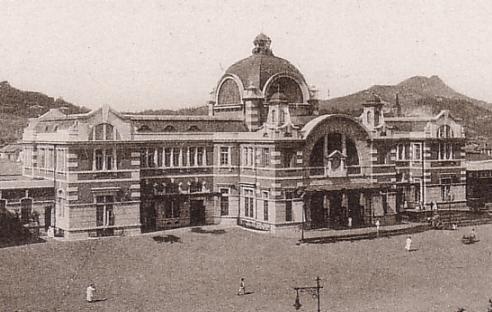 Keijō Station
Their kinship may be hard to see in black and white. Put present-day color photographs side by side, however, and it becomes immediately clear why I call them sisters.
 Exterior of Tokyo Station’s south entrance
 The station building on the west square of Shenyang Station
The same red brick, the same domes, the same bands of stone—it is difficult not to connect them, even if Shenyang Station has since been mauled by dreadful heritage restoration. All three were designed by Tatsuno Kingo or his students. Imagine a traveler from the provinces stepping off a train and emerging before one of these elegant red-brick buildings. He might feel, sincerely, that he had arrived at the center of a modern capitalist empire setting the pace of the world—imperial Tokyo—or at a center of modern colonial rule: Keijō at the heart of Japanese Korea, or Mukden at the heart of Manchuria (Keijō was colonial Seoul; Mukden is present-day Shenyang, a major city in northeast China that came under Japanese control). This was not the crumbling, dilapidated “edge of civilization” he knew, slowly disappearing beneath the colonial tide. A century ago, Tokyo Station brought a touch of modern fashion to an old city; today, it lends classical grace to a modern one. But I should return to this particular visit.
 The dome above Tokyo Station’s Marunouchi north entrance
The building has north and south entrances, each beneath its own dome. Both domes were bombed by the United States in 1945. With little money for restoration after the war, they were replaced by simple roofs and not restored until the early 2010s. No visit to Tokyo Station is complete without looking up. I stood in the middle of the hall, pointed my camera skyward, and saved the dome to my phone.
 The Marunouchi building of Tokyo Station
Many people come to Tokyo either for traditional temples and shrines or for the cyberpunk metropolis. Few seem to arrive expressly to stare at classical Western-style buildings. Traditional Japanese architecture offers the culture of wabi-sabi and yūgen; the modern city offers contemporary Japanese life as seen in television dramas and anime. But to see the turbulent century between them—to see how Japan chose and struggled, prospered and declined—you have to look at these Western buildings.
It was my birthday. How could I visit my favorite building in Tokyo without leaving myself a keepsake? I had heard that the nearby Tokyo Central Post Office sold stamps and postcards featuring the Marunouchi station building, so I went to ask.
The staff could not have been more attentive. When I said I wanted a themed postcard, they left the counter to help me find one on the shelves, helped me attach the stamp, and added a pictorial postmark. I wrote myself a birthday wish in Chinese, Japanese, and English. Outside, I photographed the postcard with Tokyo Station behind it.
 The postcard with the Marunouchi station building
From Kobayashi Kiyochika to Kawase Hasui
Nearby, the Mitsubishi Ichigokan Museum was holding City of Twilight: Shin-hanga—from Kobayashi Kiyochika to Kawase Hasui. Of all Japanese painting, what I love most is not traditional ukiyo-e of the Hokusai kind, but shin-hanga: it carries the antique fragrance of ukiyo-e together with the fresh light and shadow of Western painting. I am especially fond of Kawase Hasui’s prints. This happened to be the exhibition’s final day. What possible reason did I have not to go?
The building, too, has a story. In a Marunouchi that has long since assumed the shape of a modern metropolis, the Mitsubishi Ichigokan is the only surviving clue to “Icchō London.”
I left the exhibition thoroughly satisfied and bought its catalog from the museum shop. Since returning to Shanghai, I have often picked it up at my desk simply to enjoy the beauty of shin-hanga.
 The exhibition catalog
From the museum I walked toward Ginza. On the way I passed the Tokyo International Forum and went inside for a look. I vaguely remembered an edition of NHK’s Kōhaku Uta Gassen being held there; its glass atrium had caught my eye even then. At last, here I was seeing it in person.
 The atrium of the Tokyo International Forum
Once in Ginza, I found there was not much for me to do. Shopping is hardly the point of Japan for me. I visited Kyūkyodō, but it carried nowhere near the range of its Kyoto flagship, so after looking around for a while I left.
Tokyo Tower
Later that day, a friend asked why I felt the need to climb Tokyo Tower. Was it not enough just to see it from outside? I showed her the model of the tower in my hand, and she seemed to understand. In truth, that was not why I went up: the model was available in the gift shop at the base, so why pay for admission merely to buy it? Perhaps it was simply an obsession. If I had come to Tokyo, I had to see Tokyo Tower. Seeing it from below was not enough; I had to go up, as though only then could I leave without regret—much as so many visitors to Shanghai insist on ascending the Oriental Pearl TV Tower (the city’s unmistakable landmark).
 The Tokyo Tower model I bought on the observation deck. By chance it is almost the same scale as a Tokyo Skytree model I already owned; both now stand on my desk at work
I once saw a film that I think was called Always: Sunset on Third Street. Near the end, the owner of an auto repair shop and his family puttered beside the railway in a battered little three-wheeler (it reminded me of the tiny low-speed electric cars jokingly called “old people’s runabouts” in China). They had come to see off a young employee aboard the train. Together, they looked toward the newly completed Tokyo Tower on the distant skyline. What must that great orange-red tower have meant to their generation?
 What must that great orange-red tower have meant to their generation?
Perhaps seeing Tokyo Tower brought back the days when they had struggled for the future, full of hope.
 On Tokyo Tower
At the tower’s northeastern corner is an official self-portrait spot where visitors can set down a phone and take a photograph from a fixed angle. It neatly solves the problem of traveling alone with nobody to photograph you and the tower together.
 A photograph with Tokyo Tower
Birthday Night
Two younger women from my lab happened to be traveling in Tokyo at the same time, so I invited them to celebrate with me. Before university, birthdays had been family occasions; after leaving home, I had spent them alone. This may have been the first birthday I ever celebrated with friends. I had originally imagined booking a Marunouchi restaurant overlooking Tokyo Station at night, or somewhere near Tokyo Tower with a view of the illuminated tower. Cost intervened, and dinner became yakiniku in Roppongi. The restaurant was lovely. I had reserved its birthday set in advance, and when we arrived, they had kept us a table by a great window.
A birthday night calls for a bottle—or at least a glass. I ordered white wine; they raised fruit juice in its place, and we clinked glasses. That was my birthday toast. One detail deserves special mention: the “cake” in the birthday set was made of beef. It was a yakiniku restaurant, after all.
 Cheers!
 A photograph with the cake
 The view from the restaurant was rather good, too
After dinner I suggested walking from Roppongi to Tokyo Tower to see it at night, but they were tired and wanted to return to their hotel. And so another nocturnal excursion through Tokyo became mine alone.
 In fact, Tokyo Tower came into view fewer than fifty paces from the restaurant
I had also hoped to see the Sangedatsumon Gate at Zōjōji beside the tower; I knew the building from a Kawase Hasui print. It was undergoing restoration, however, and had been sealed behind construction hoardings. I would not be seeing it this time.
 Sangedatsumon as depicted by Kawase Hasui
Day 2. A Day in Ueno
The main purpose of the day was the Tokyo National Museum, with a little wandering around Ueno along the way.
Kyu-Iwasaki-tei
I have very little to say about this house. Only this: how wonderful it would be if, one day, I could live somewhere like it. To sit inside, looking out over the lawn, sunlight pouring in through the windows—oh, just imagine.


Boating on Shinobazu Pond
I first came to know Shinobazu Pond through Kawase Hasui’s prints.
 Pondside at Night — Kawase Hasui
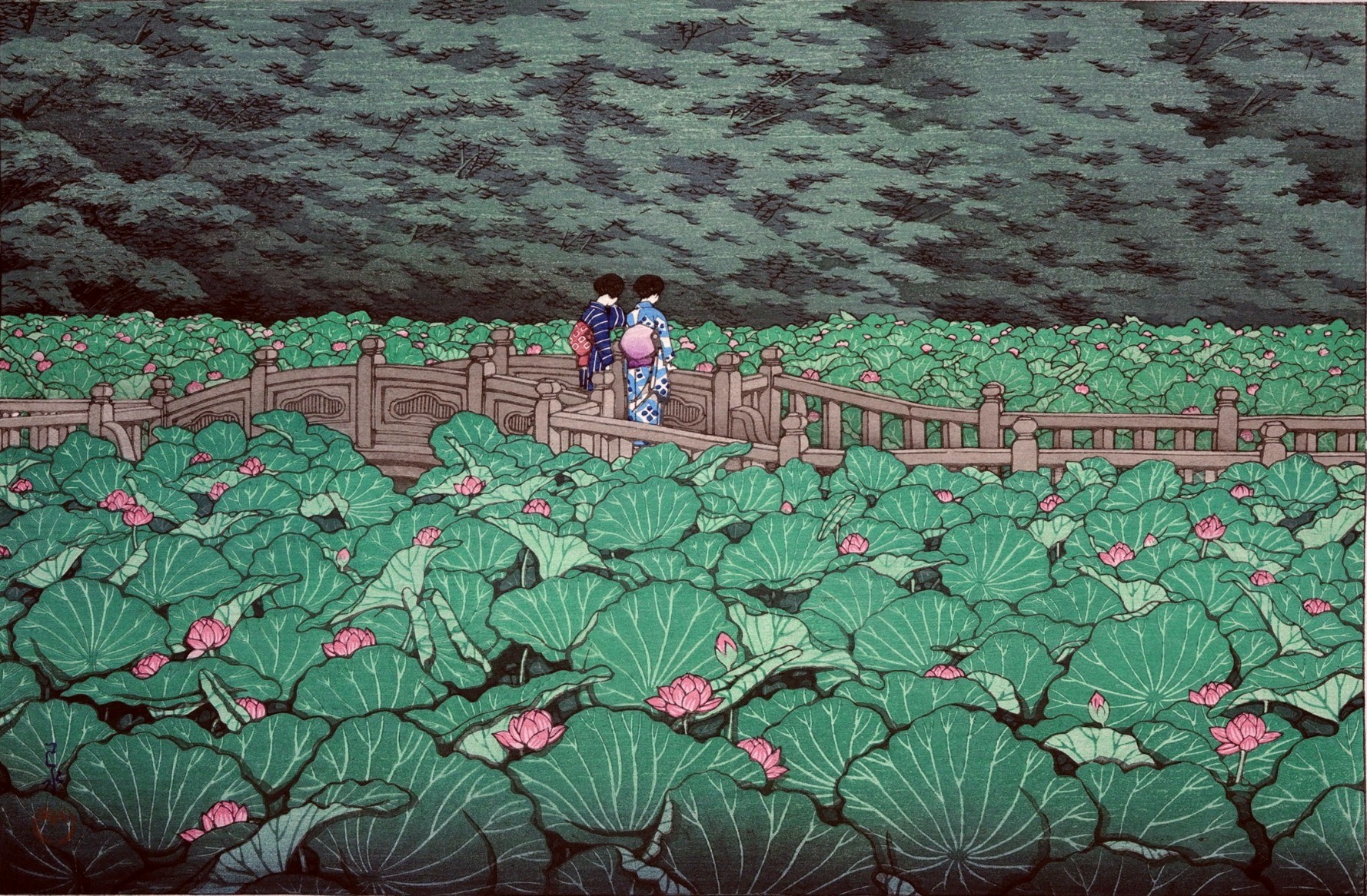 Shiba Benten Pond — Kawase Hasui
The moment I saw that duck boats were available, I rented one without hesitation. Here, they let you row alone. Every time I visit West Lake (in Hangzhou), I want to hire a boat and never manage it, because rentals require at least two people—presumably for fear that I might jump into the lake. My wish to drift across a lake was finally granted in Tokyo.
 A duck boat from the driver’s seat
Truthfully, Tokyo’s duck boats were no different from those I rode as a child back home (in Inner Mongolia). Why, then, did I have to come all the way to Tokyo to row one?
Tokyo National Museum
I had heard that the Tokyo National Museum held many treasures. It was a museum of global renown, and I came on the strength of that reputation.
The Japanese Gallery in the Honkan is the museum’s basic permanent display, rather like Ancient China (the foundational permanent exhibition at the National Museum of China in Beijing). I had looked forward to it before the trip. In Japanese material culture, I am chiefly interested in art and design—architecture, gardens, painting, and craft—so I expected to find a wealth of Japanese paintings and decorative objects here.
 The Honkan of the Tokyo National Museum
I had always imagined the Honkan to be comparable in scale to the National Museum of China: a monumental museum building. When I arrived, it did not look especially large. A walk inside confirmed it.
 The central staircase of the Tokyo National Museum’s Honkan
The central staircase is apparently famous. I first saw it in the television drama Hanzawa Naoki, where it stood in for the lobby of Tokyo Chuo Bank. Even on screen, I marveled that a hall could look so imposing. Today I finally saw it with my own eyes.
The scale of the building and its collection disappointed me, however. Perhaps I simply have little interest in Japanese archaeology or samurai culture: the prehistoric stone and bronze objects and early-modern armor did not draw me in. The ukiyo-e, Nishijin textiles, and other works of art seemed ordinary, scarcely different from what one sees outside a museum. As for calligraphy and literati painting, their artistic quality could hardly compare with the Chinese works I had seen in museums back home. Once one has seen the ocean, perhaps other waters really do fail to impress.
I was already tired, and the Honkan bored me so thoroughly that I nearly fell asleep on my feet as I walked through it. Outside, I bought a margherita pizza from a food truck in front of the Asian Gallery, ate it, and slept for an hour or two beneath an awning in the plaza. Only after waking did the fog begin to lift from my head.
Compared with the Japanese collection, the Asian Gallery held genuine masterpieces. Its Japanese name is Tōyōkan (the characters 東洋 often denote Japan in modern Chinese usage, whereas the Japanese tōyō means “the East” more broadly—East Asia, or Asia as a whole, in contrast to seiyō, “the West”; hence a gallery with this name contains far more than Japanese art).
There were many Chinese artifacts that had found their way abroad. During the last century, Japanese “expeditions” traveled deep into China to “explore lost antiquities,” then carried them back to Japan for study and display. The Asian Gallery includes no shortage of objects removed from famous Chinese sites such as the Yungang Grottoes. I have not yet visited Yungang, but when visitors there see a Buddha missing from a cave, do they wonder where it went? Here in Tokyo, I learned the answer. (For a Chinese visitor, this is no neutral matter of provenance: the empty niches belong to the still-living memory of cultural objects lost during a century of foreign incursions.)
 Chinese statue of Guanyin in the Tokyo National Museum, from Zhangzi, Shanxi
The greatest surprise in the Asian Gallery, however, was its collection of Gandharan Buddhist sculpture. Gandharan figures combine the spiritual resonance of India in the East with the rational proportions of Greece in the West; it is no exaggeration to call them some of the finest works in the history of sculpture. I have written before that Song-dynasty statuary is my favorite because its expressions—and especially its eyes—give divinity a human nature and human feeling (see my Microblog). Where Chinese sculpture labored over the spirit of a deity, Gandharan sculpture inherited a tradition from the West and excelled at the form.
 Gandharan statue of Śākyamuni in the Tokyo National Museum
This Śākyamuni is the figure I could not forget. I do not know whether it was the sculpture itself or lighting designed especially for it, but after taking this photograph I could not shake the feeling that the Buddha was looking at me in perfect calm.
I made only a quick circuit of the Chinese, Korean, Middle Eastern, and Egyptian collections. I had seen many artifacts from those civilizations before, and these did not especially stir my curiosity; to an outsider looking with an artistic, aesthetic, or frankly novelty-seeking eye—I am no historian or archaeologist—they seemed much like things I had already seen. Gandharan art was different. I had never encountered it in person. Outside the Tokyo National Museum, it is difficult to see Gandharan antiquities in East Asia. I had admired them from afar for years without ever meeting one. Finding them here was an entirely unexpected pleasure.
After leaving the museum, I went to Ueno Tōshōgū to see its five-story pagoda, a motif that appears often in Kawase Hasui’s work.
The five-story pagoda of Ueno Tōshōgū, by Kawase Hasui
Faced with the real thing, I had to admit that it looked much like every other five-story pagoda. Perhaps Hasui painted it so often because it was convenient. The light was poor—it was nearly dusk—and trees obscured the tower, so I took no photograph. Beside the approach outside the shrine, though, a single flower caught a beam of evening sun. It was so beautiful that I made a portrait of her instead. The photograph, unfortunately, could not capture her proud little temperament.

Day 3. A Journey to Kamakura
The Sea by Day
The forecast suggested this might be the only clear day of the trip, so I decided to go to Kamakura and see the sea. The ocean, after all, looks best beneath a clear sky. I invited the two younger labmates who were in Tokyo as well; when they had visited Kamakura a few days earlier, I heard, it had been all wind and rain.
Up to that point I had seen the sea three times: once in Dalian, once in Qingdao, and now here. I have a particular fixation on seascapes, which may be understandable for someone who grew up on the edge of the Gobi. Yet every time I go, I only look from a distance. The closest I had come was in Qingdao the year before, pacing back and forth through the shallows in sandals. In Kamakura, too, I merely stood on the sand and watched. The moment the sea appeared, all the fatigue and irritation of standing for more than an hour on the train vanished. The sea is a miraculous thing.

This beach felt different from those I knew in Dalian and Qingdao. In Dalian—or Lüshun, to be precise, since Dalian itself has stony shores—I had the entire sea to myself. In Qingdao, the sand was full of exquisitely groomed tourists playing at being white middle-class holidaymakers beneath parasols, and parents orbiting their children. Here, people were sparse, but I could tell that they had truly come for the sea. There were many surfers. Perhaps they too had seen the rare clear forecast and brought their boards out to breathe. They looked as though they had belonged to the water all along.
 Surfers at Shichirigahama
On a truly clear day, Mount Fuji can be seen in the distance from Shichirigahama. Unfortunately, the weather was not as fine as we had imagined. One of my companions blamed me for not bringing a camera: with a telephoto lens, she insisted, I would certainly have captured it. With a lens made by extraterrestrial technology, perhaps. With optics alone, I doubt even the Hubble Space Telescope would have helped.
After wandering around Shichirigahama, we reached Kamakurakōkō-mae Station. The railway crossing beside it may be the most famous railway crossing in the world. I have no interest in that basketball manga, and neither of my companions asked to stop for photographs. We walked straight across, caught the Enoden to Enoshima, and continued to Fujisawa for lunch.
Lunch was a hamburger steak over rice. It was awful, perfectly in keeping with my impression of Japanese food. Halfway through the meal, however, the woman sitting opposite me suddenly pointed through the window: “Mount Fuji!” All morning we had been guessing whether a barely visible peak in the distance might be Fuji, though it never quite looked right. I turned at once and could hardly see it. “Just go outside and look,” she said. I abandoned the rice—which was tougher than an eraser—and ran out. Once my eyes adjusted, there it was indeed.
Afraid it would disappear again, I wanted to photograph it while I still could. The most important thing was finding the right foreground. I ran across the road, over a large bridge, and into a fishing harbor. Fishing boats, I thought, would make a fine foreground. I took the photograph and discovered that the boats were so conspicuous one could scarcely notice Mount Fuji in the distant haze.
 Can you find Mount Fuji in this photograph?
I changed tactics and tried to replace the foreground with nothing but sea—difficult from the angle of this coast. I ran to the end of the pier only to find a breakwater extending farther out into the water. So I doubled back, climbed onto it, ran to its end, and took this. It just about counts as a photograph of Mount Fuji, I suppose.
 Mount Fuji
By the time I returned to the restaurant, the rice was cold and even worse. Fortunately, I had also ordered fries. It is difficult to make potatoes taste bad, especially after deep-frying them. When we finished, we discussed where to go next; we could hardly sit staring at the sea until nightfall. I suggested the Great Buddha of Kamakura, they agreed, and we boarded the train back toward Kamakura. By the time we left the restaurant, Mount Fuji had vanished exactly as expected.
On the way to the station, I noticed what looked like a teahouse. We went in to rest our feet and drink a bowl of matcha. I ordered matcha and a piece of yōkan. Neither of them cared for matcha: one chose ice cream, the other what I think was fruit tea. The matcha was unremarkable, but the yōkan was excellent. The woman with the ice cream found a piece of yōkan inside, and her eyes suddenly lit up. She had never tasted a confection with such a texture—perhaps she had never had yōkan at all—and immediately wanted to buy some. Only when she paid did I realize that this was not really a teahouse but a shop devoted to yōkan. I later regretted not buying some with her to take home. The shop was called Tamaya, on the road between Enoden’s Enoshima Station and Enoshima itself.
 Matcha and yōkan
Kamakura
At the Great Buddha, my two companions learned that admission required a ticket and decided to wait in the souvenir shop. Buddhist statuary did not interest them. A little later, I received a message: they had gone straight back to Shichirigahama to take photographs, and I should meet them there before sunset. Kamakura, then, was mine alone once more.
 The Great Buddha of Kamakura
Truthfully, the Buddha did not interest me very much either. Why insist on going in? Perhaps because so many anime send their characters to the Great Buddha on summer trips, and I felt obliged to make the pilgrimage myself.
Afterward, I took a bus toward Tsurugaoka Hachimangū. Perhaps I boarded the wrong service, or perhaps I forgot to get off; either way, I traveled one stop too far to a station called “Daigaku-mae” and had to retrace my route. How had I first heard of Tsurugaoka Hachimangū? Through Kawase Hasui, yet again.
 Tsurugaoka Hachimangū as depicted by Kawase Hasui
 My photograph from the same angle
Kamakura was the seat of the Kamakura shogunate, Japan’s first warrior government. I have little interest in the samurai, but the city plan still carries the unmistakable air of a capital. Tsurugaoka Hachimangū is its absolute center, and the broad avenue of Wakamiya Ōji extends from the shrine gates with something of Heian-kyō about it.
 Central Kamakura seen from the heights of Tsurugaoka Hachimangū
It was around five in the afternoon when I arrived, and few visitors remained. I have little to say about the architecture itself; Kansai had already shown me many more remarkable shrines.
 Tsurugaoka Hachimangū from a distance
One thing was different: I bought omamori here. In the past, the most I would take from a shrine was a goshuin. Superstitious amulets were beneath me. This time I bought two, partly because they were beautiful and partly because—what if they actually worked? One was an ordinary protection charm bearing the shrine’s tsurumaru, a crane enclosed in a circle. It is a genuinely fine design; Japan Airlines, incidentally, uses the same crane emblem. I chose purple for its air of nobility. The other was an enmusubi charm for fateful bonds. It too was lovely: powder blue and pink, with one blue and one white tassel. The white tassel wrapped in red cord reminded me of a shrine maiden, or a bride in her white shiromuku… Having taken home this charm, perhaps the person destined for me would soon be tied to me as well. That was what I thought.
 The first omamori
 The second omamori
Leaving the shrine, I returned to Shichirigahama to meet the others.
The Sea at Dusk
When I arrived, I found them sitting lazily by the water. So they truly had spent the whole day doing nothing but looking at the sea.
There are no words for watching evening fall beside the ocean. From this angle we could not see the sun itself, only the afterglow; even the sky was not red, merely lit by the residue of sunset. At such a moment the mind neither thinks nor needs to think. Later, memory neither can nor needs to write anything down.
 The shore at dusk
I was holding up one of the omamori to photograph it when one of them took a photograph of me from behind, with the evening sea as the background. For someone who has grown—by necessity—accustomed to traveling alone, having companions at least meant that I came away with one of the journey’s few photographs of myself.
 A portrait in the evening light
Night on Tokyo Bay
They were flying back to Shanghai from Haneda that night. We rode together as far as Yokohama, where we separated. After stepping off the train and saying goodbye, I called after them, “I was really happy spending these past few days with you.” They smiled and went on their way.
On the train back to Tokyo, I considered dinner. I was not about to repeat the disaster of lunch. I searched for good Chinese restaurants and settled on a Shaanxi place in Shimbashi called “Spicy Sister”—or was it “Spicy Flavor Sister”? I forget. Shimbashi Station was the starting point of Japan’s first railway, for one thing, and the opening line of The Railway Song begins, “With a whistle, from Shimbashi…” For another, after dinner I could take the Yurikamome from Shimbashi to Odaiba and see Tokyo Bay at night. Most importantly, online reviews said its yuxiang shredded pork was good. I like yuxiang shredded pork.
When I arrived, the proprietress was tidying up: a private booking had just ended. She greeted me first in Japanese. I paused—even though I actually understood her—and she switched seamlessly into Mandarin. I ordered yuxiang shredded pork, only to be told there was no shredded pork left. In China I might immediately have found another restaurant. Here, I resigned myself to a bowl of youpo mian, noodles splashed with hot oil. As a Chinese person, the first time I ever ate them was in Tokyo; the first time they made me sweat from the heat was in Tokyo, too.
Afterward I took the Yurikamome to Odaiba Seaside Park, one of the finest places to see Tokyo Bay at night. Few places other than Odaiba let you take in both the sea and Tokyo’s skyline at once.
 Tokyo Bay at night: Rainbow Bridge and Tokyo Tower
Odaiba also has a Statue of Liberty. Seeing one in Tokyo is, frankly, a little disorienting.
 Tokyo Bay at night: Rainbow Bridge, Tokyo Tower, and the Statue of Liberty
On the evening of the 23rd—my birthday—there had happened to be a fireworks display at Odaiba Seaside Park. I had originally planned to reserve a restaurant there and watch the fireworks from the window. What a beautiful birthday memory that would have been. Cost and the shape of the itinerary eventually persuaded me to abandon the idea.
Along the shore I saw couples everywhere, and guests from the Hilton Tokyo Odaiba wandering out in their pajamas to enjoy the night view. If I return to Tokyo, the Hilton will be my first choice of hotel—provided my finances allow it by then.
It was almost midnight when I left Odaiba.
Day 4. Nagatachō, the Imperial Palace, and Tokyo Station
The first three days had probably exhausted me. On the fourth, I thought I would visit one place and let chance decide the rest.
Visiting the National Diet
I am interested in Japanese politics. I am also very interested in the architecture of the National Diet Building.
I first noticed it because of another building that looks remarkably similar.
 The former State Council building of Manchukuo in Changchun; photograph by the author
 The former State Council building of Manchukuo in Changchun; photograph by the author
I attended university in Changchun. During the Japanese occupation, the city served as the capital of Manchukuo (the Japanese puppet state established in occupied northeast China, remembered in China as an instrument of invasion and colonial rule). The Japanese naturally lavished attention on it, planning it to the standards of an “imperial capital” modeled on Tokyo. Among Manchukuo’s government buildings, none surpassed the State Council in status or refinement. During my four years in Changchun it became the most frequent motif in my photography, and I grew deeply attached to it (see First Prize in Jilin University’s Student Photography Competition: Fengyun Jichu Building).
Its form, and especially its tower, clearly borrows from Japan’s National Diet Building, localized through the so-called “Manchurian style.” I remember its architect explicitly saying that the design also drew on Beijing’s Forbidden City. My interest in the Changchun building naturally extended to its original—or sibling. And as the building that appears most often in Japanese political news, the Diet was somewhere I had to enter while in Tokyo.
I planned to get up in time for the House of Councillors tour at two. I had first wanted to visit the House of Representatives, but heard that it did not accept foreigners—or, more precisely, people who could not speak Japanese. I did not feel like testing my half-baked Japanese. The upper house was said to be friendlier to foreigners, so the House of Councillors it was.
Emerging from the subway, I first saw the Prime Minister’s Official Residence and Office. The residence has something of Frank Lloyd Wright’s Prairie houses about it, while its interiors carry hints of Art Deco and the Maya Revival. It reminded me of a related building: Wright’s original Imperial Hotel in Tokyo. I doubt I shall ever tour the residence myself—it is, after all, where Japan’s prime minister lives—so glimpses in news footage and archival material will have to suffice. Japanese and Philippine flags hung from every lamppost nearby.
 The Prime Minister’s Official Residence
 The Prime Minister’s Office
I reached the visitors’ entrance twenty minutes early. Security told me that the two o’clock session would be a “simplified tour”: no guide, no pauses, just a walk through. If I wanted the full version, I could return at three. Since I was already there, waiting for the complete tour seemed worthwhile. Nagatachō is all government offices, with few amenities for ordinary life or tourism. The only place to rest was a bench in the Diet’s front garden, where I waited for an hour. Behind it stood Japan’s Fundamental Benchmark. It is apparently an important piece of geodetic infrastructure, but clearly not an attraction worth stopping for. Nobody examined the pattern on its pediment except someone like me, stranded there with time to kill.
 Japan’s Fundamental Benchmark
Near three, I returned to the visitors’ entrance. Something felt increasingly wrong as I approached. Lines of primary and secondary school students filled the pavement; tour buses crowded the road. With so many school groups, could there possibly be places left? As expected, security said the three o’clock tour was full. I asked about four. He did not know. My heart sank. Four was the final session of the day; if the same thing happened again, would I not have wasted an entire day? I was furious, but could hardly unleash that fury on the guards at Japan’s parliament. I had to find somewhere to wait for another hour.
I certainly was not going to roast on the same bench for sixty more minutes. Was there a restaurant or café nearby? Astonishingly, yes, even in this godforsaken district: a tiny coffee shop beside the Supreme Court, ten minutes away on foot.
It occupied a half-basement. The entrance could not have been an ordinary door; it must have been one of Doraemon’s Anywhere Doors. Otherwise, why did opening it carry me instantly into the Shōwa era, perhaps even the Taishō?


The café was tiny: a single counter and perhaps five or six seats. Apart from two elegant older ladies talking together, it was empty. The room was so tight that the passage before the counter barely admitted one person. Dark wooden shelves, tables, and chairs bore a grain that immediately betrayed their age. The opposite wall was filled with coffee cups, any one of which could have claimed to be a work of art: Japanese, Chinese, Middle Eastern, European; classical and modern; every style and every pattern, though the overall impression was one of old-fashioned elegance. Had I skipped the Tokyo National Museum the day before and spent a full day studying these cups instead, I might have had much more fun.
While I stood in a daze, a woman in her eighties emerged from the kitchen. I began to wonder whether the café had existed since her youth. With no sense of hurry, she handed me a menu, then continued, just as unhurriedly, to arrange the coffee ware. The entire menu was in katakana. Too lazy to decipher it character by character, I chose what appeared to be the house specialty.
She then pointed toward the cabinet of cups, indicating that I could choose one to drink from. Only then did I realize they were not exhibits. I selected the blue checkered cup; its pattern reminded me of Katsura Imperial Villa, which I had visited the year before.
 The ‘Katsura Imperial Villa’ coffee cup
By the time I finished the coffee, it was nearly four. I said goodbye to the proprietress and set off for the House of Councillors. Mercifully, I saw no school groups on the way, and they admitted me when I reached the entrance.
Beneath the building is a visitors’ hall with an exhibition on the history of the House. Everyone waits there, then forms a line at the appointed time and follows a staff guide. I was the only foreigner, and a member of staff came over especially to place me at the front. He asked whether I spoke Japanese. “Chotto,” I said—a little. He pointed at a notice on the wall and told me to “lead it.” For a foreigner like me, being made to lead an entire line of visitors was an act of social terrorism, but I did not know how to refuse, so I froze. After several failed attempts to communicate, the guide gave up.
The visitor behind me looked like a cultivated, middle-aged intellectual—perhaps a university professor. “His English is not good,” he said. “Do you understand the rules on the wall?” Only then did I realize the guide wanted me to read the notice. I turned around. “He said ‘read,’ not ‘lead.’ Right?” The man promptly “corrected” my pronunciation: “ru-i-do.” (The Japanese r is an alveolar tap that can sound to English ears somewhere between r and l, while Japanese syllable structure inserts vowels into foreign consonant clusters; thus read emerged as something like ru-i-do.) Pretending enlightenment, I said, “Japanese English.” He could not help laughing, then added on the guide’s behalf, “So-ri”—sorry. Merriment rippled up and down the line.
Throughout the tour, both the guide and the gentleman courteously kept me at the front. Whenever I stopped for a photograph and fell behind, a security officer would come looking, then escort me back to the head of the line. Perhaps this was hospitality toward a foreign guest; perhaps it was a matter of national security. Either way, being a foreigner in Japan felt marvelous.
We first entered the chamber of the House of Councillors. Unlike in photographs online, no explanatory signs had been hung inside. Perhaps a sitting had only just ended, I thought. All the better: the view was unobstructed. The chambers of the two houses are arranged in much the same way, with one distinction—the Emperor’s throne. As in Britain, the monarch does not enter the lower house. In the House of Representatives, therefore, the throne hangs high within an inaccessible alcove; in the House of Councillors, it occupies a ceremonial space that can actually be entered and used. At the opening of each parliamentary session, even members of the House of Representatives must come to the upper chamber to hear the Emperor’s address. Ordinarily, the throne is hidden behind white curtains.
 The chamber of the House of Councillors
We sat in the public gallery on the second floor while the guide spoke. To the extent that my half-baked listening allowed me to understand, he explained Japan’s political system, the Diet, and the role of the House of Councillors. A question-and-answer session followed, in which visitors could ask anything about Japanese government. The explanation was clearly written for school groups and ordinary Japanese citizens, and most questions came from children. Opening parliament to visitors is a form of civic education: it lets citizens, especially students, experience directly how national government works. I knew at least the basics of Japanese politics, and my Japanese was poor, so I stayed out of the questions.
The chamber’s decoration was also exquisitely detailed and suitably luxurious, though I doubt many people come for that.
We next went to the Emperor’s Room. The rules said photographs were forbidden along the way unless the guide granted permission, but shutters clicked without pause.
When the Emperor comes to the Diet for a ceremony, he can hardly arrive and march straight into the chamber. He needs somewhere to rest. Befitting his position, that room lies at the heart of the building. Its decoration immediately made me think of the Meiji Palace—the imperial residence built after Emperor Meiji moved to Tokyo and destroyed by American incendiary bombs in 1945. At first glance, one cannot tell whether this is Kyoto Imperial Palace or Akasaka Palace. Yet it is the Meiji Palace—or rather, the Emperor’s Room. A coffered and folded ceiling, traditional clouds and birds painted on the walls, gilded motifs on black wooden doors: all unmistakably Japanese. Turn your head, and crystal chandeliers, lace sheers, red curtains, dark wooden chairs, and patterned carpet make it entirely a European palace. None of this surprised me. In my imagination, the room had always been destined to look exactly this way.
 The Emperor’s Room in the National Diet Building
Beside it was the room for other members of the Imperial Family. The style was similar, though conspicuously more modest.
 The Imperial Family’s room in the National Diet Building
Opposite the Emperor’s Room is the central staircase, connecting the central hall below with the room above. It shifts one’s architectural attention away from Kyoto or Paris and toward Rome.
 The central staircase of the National Diet Building
The central hall came next, though we reached it by a considerable detour. We clearly looked nothing like the Emperor or his family, so naturally we were not allowed to descend the central staircase directly. Where the chamber and resting rooms smelled of timber, the hall belonged wholly to stone. It rose uninterrupted from the ground floor to the top of the tower. The coffered ceiling above did not look Japanese to me but Chinese, especially with layer after layer of bracket-like forms around it. I was probably mistaken. The architect surely cannot have intended anything of the kind.
 The central hall of the National Diet Building
 The coffered ceiling above the central hall
Outside at last, I could inspect the façade up close. Four Roman columns support the projecting porch at the main entrance—I have genuinely forgotten the proper Western architectural term. They resemble simplified Corinthian columns, though the capitals are clearly Japanese in character.

One glance at the whole building explains why I find it so similar to its counterpart in Changchun.
 The National Diet Building
Marunouchi at Night
Unlike the usual image of Tokyo as crowded and hurried, the Imperial Palace Plaza is one of the rare places in the city where the world feels open.
 The Imperial Palace moat, Sakurada Gate, and the Marunouchi business district
On the way to Sakurada Gate, I saw more and more runners. Perhaps they worked nearby and came out for a run after the office closed. This may be Tokyo’s only truly open space; running here would clear the mind as well. Only the Emperor commands enough prestige to keep such a broad expanse empty at the center of Tokyo.
Looking west from Sakurada Gate is Kasumigaseki, home to most of Japan’s central government ministries. Before the war it too was full of Western-style buildings. Today, only the former Ministry of Justice—just visible in the photograph—remains. It can be toured as well, but there is no need to enter every Western building in Tokyo. If curiosity becomes unbearable, a look on Google Earth will do.
 Kasumigaseki
The Imperial Palace, residence of the Emperor, was once Edo Castle, home of the Tokugawa shoguns. After the Tokugawa were removed from power, the castle naturally passed to the country’s new master. Tours of the palace can be reserved. Had the Meiji Palace survived, I would gladly have made the effort to book one. The present palace is modernist, however, and visitors can see it only from outside, so I did not trouble myself.
 The stone bridge at the main entrance to the Imperial Palace
One would think a modern skyline had little left to offer me after so long in Shanghai. Yet returning to Marunouchi that evening gave me a different sensation: clean, ordered, quietly luxurious. In Puxi, the warmth and mess of ordinary life dissolve the rationality of towers, while silent plane-tree avenues swallow modern prosperity. In Pudong, multicolored neon ruins everything. Here, taste and luxury are expressed through detail and restraint. The breadth of the palace plaza gathers the towers into a single posture and presents them together before the eye. Yellow lights reflected in the moat complete the night scene. It really is unlike Shanghai.
 Marunouchi at night, beside the moat of Edo Castle
Tokyo Station is, of course, Marunouchi’s visual center. The avenue between the station and the palace is Gyōkō-dōri, the Imperial Progress Avenue, used by the Emperor on formal journeys. When foreign ambassadors present their credentials, they too often travel from Tokyo Station to the palace along it in a royal carriage. In recent years, its center has been remade as a stone-paved promenade, lined with classical Western lamps. With Tokyo Station at the far end, the scene evokes the elegance of a European court. Seen head-on at dusk, the station’s illuminated red brick is a hundred times more enchanting than by day, like aged red wine in yellow candlelight. Gyōkō-dōri was crowded with grooms in tailcoats and brides in white, holding hands and smiling for cameras. Evidently I was not alone in thinking so.
 A newlywed couple on Gyōkō-dōri, with Tokyo Station at night
Tokyo Station
On my first day, I bought a 1:2400 model of Tokyo Tower from its observation deck. Later, searching online, I discovered that it belonged to the GEOCRAPER series—a line of miniature city blocks that can be joined into an entire metropolis at 1:2400 scale. Anyone familiar with architectural miniatures will probably know the brand. That is beside the point. The important discovery was that my tower belonged to the Tokyo Landmarks series, and another model in that series was the Marunouchi building of Tokyo Station.
The Tokyo Tokyo website—a tourism brand run by the metropolitan government—said that, besides an online shop, two brick-and-mortar locations carried the model: the Tokyo Station Hotel and the Kinokuniya bookstore in Ōtemachi. Neither was far from Marunouchi.
The Tokyo Station Hotel occupies the station building itself. It is a small, venerable boutique hotel that opened with the old station. A Tokyo Station model seemed an entirely reasonable thing for it to sell. Earlier, I had emailed the hotel to ask whether the front desk stocked one, but had not yet received a reply. Since I was at the station again, I went in to ask. The receptionist was unfailingly polite. He checked the computer, then disappeared to consult someone elsewhere. After staring for a while at the large-scale model in the hotel lobby, he told me that the front desk did not sell it. I thanked him and hurried out to catch the next bus to Ōtemachi. It was only a ten-minute walk, but after a full day my feet had begun to hurt, and Kinokuniya would close in less than half an hour.
Once there, I simply could not find the shopfront. I circled the tower again and again, my feet aching violently and my anxiety rising just as sharply; closing time was now only minutes away. At one point I began to suspect that the Kinokuniya marked on Google Maps had never existed. I tried the entrances one by one and finally found the bookstore in an indoor passage tucked into a corner. Unlike the bookstore I had imagined, it was full of books—imagine that—and showed not the faintest trace of designed souvenirs. I searched until closing and found no Tokyo Station model. Only later did I learn that the shop had stopped selling anything other than books and magazines several years earlier. The Tokyo Station Hotel’s physical souvenir shop had closed years ago as well.
Spirit crushed, I opened Amazon on my phone, found the model, ordered it, and had it delivered two days later to the FamilyMart beneath my hotel.
 The Tokyo Station model
Two days later, the hotel’s food and beverage manager replied to my email and asked when I would be visiting: they could prepare as many as thirty models at reception for me to purchase. I explained everything that had happened, then added: if a hotel housed in such a beautiful heritage building regularly offered this model at its front desk, both guests and visitors would feel their trip had been worthwhile. My research suggested it was the only consumer model of the building in existence. He apologized with perfect courtesy and said they would seriously discuss my suggestion. Whether heartfelt or diplomatic, it was impeccable emotional first aid.
Day 5. Tokyo Love Story
Young readers like me may see this heading and expect some romantic encounter in Tokyo. Anyone a little older will probably know exactly what these words refer to. (For many Chinese viewers of that generation, Tokyo Love Story, the 1991 Japanese television drama, was a defining imported romance.)
Meiji Shrine
Meiji Shrine enshrines Emperor Meiji and Empress Shōken. Given that he was arguably one of the most important figures in modern Japanese history—and perhaps even “one of” is unnecessary—it is not difficult to understand why an immense natural forest was set aside in central Tokyo, then still on the outskirts, and a shrine built for his worship. Because its principal deity is an emperor, it is called a jingū, an imperial shrine, rather than an ordinary jinja. Other examples include Ise Jingū, dedicated to the imperial ancestor Amaterasu, and Heian Jingū, dedicated to Emperor Kanmu, who moved the capital to Heian-kyō. One exception was the Jianguo Temple in Manchukuo, a shrine to Amaterasu once located in the grounds of the puppet imperial palace in Changchun (Manchukuo was Japan’s puppet state in occupied northeast China). Perhaps it was called a temple because, in Chinese tradition, places dedicated to emperors are also called miao.
I had not come especially to worship the emperor who, legend says, lived frugally so Japan could buy warships to confront Qing China (for a Chinese visitor, the association is pointed: Japan’s defeat of Qing China in 1894–95 remains one of the foundational humiliations in modern Chinese historical memory). One reason was simply that no account of Tokyo’s shrines can avoid Meiji Shrine. It is the city’s most important Shinto sanctuary, and at New Year a great part of Tokyo comes here for hatsumōde, much as Beijingers hurry to Yonghe Temple (the city’s best-known Tibetan Buddhist monastery) to burn the year’s first incense. National feeling aside (for a Chinese visitor, the history of Japan’s wars in China is impossible to miss), I am also deeply interested in Emperor Meiji as the man who set Japan’s turbulent modern century in motion.
I got off at Yoyogi Station and entered the forest by the northern approach. Enormous trees turned the path into pure landscape; anyone walking beneath them could easily forget that they stood in the center of one of the world’s most prosperous cities. Near the shrine rises its great torii. It is immense—perhaps, in my memory, surpassed only by the torii of Heian Jingū. That one is so large, and its surroundings so empty, that standing near it can provoke a fear of gigantic things.
The original Meiji Shrine torii was made from a 1,200-year-old tree brought from Alishan in Taiwan, by then a territory of the Japanese Empire. (“Territory” is deliberate: official Japanese narratives classed Taiwan, Korea, Dalian, southern Sakhalin, and Micronesia as the empire’s gaichi, or outer lands, paired with the Japanese islands as naichi, the inner lands; their status was not identical to that later assigned to Manchukuo, occupied China, or Southeast Asia.) Lightning destroyed the torii after the war. Its replacement was made from a 1,500-year-old tree from Taiwan’s Danda Mountains—purchased this time.
 The great torii of Meiji Shrine
Inside the shrine, the architecture once again gave me little to say. The two great trees before the worship hall interested me far more. Their near-perfect hemispherical forms were plainly the result of meticulous pruning. They also reminded me of the two trees planted before the Shishinden at the ancient imperial palace—the inner palace, or in another sense the harem. The Shishinden was roughly analogous to the Palace of Heavenly Purity in Beijing’s Forbidden City and later also assumed something like the role of the Hall of Supreme Harmony. An orange tree stood to its left and a cherry to its right, as they still do at Kyoto Imperial Palace. I could not help wondering whether these two pairs of trees were related.
 The worship hall of Meiji Shrine
At the amulet counter opposite the Kaguraden—perhaps “shop” is an improper word for a place selling omamori—I paid 100 yen to draw a poem-fortune called an Ōmikokoro. Unlike ordinary shrine fortunes, which pronounce good or bad luck, Meiji Shrine offers poems composed by Emperor Meiji and Empress Shōken, each carrying a lesson for life. Mine was one of the emperor’s poems, titled “Water”:
Even while yielding
To its container’s form,
Water too can pierce
Entirely through the hardest rock;
Such is its enduring strength.
To adapt to circumstance like water, yet possess the power to break through all things: that is precisely the self I aspire to become. Evidently this draw was not random but truly reached into my heart. Though I cannot rule out the possibility that I merely read myself into it afterward.
 The Ōmikokoro I drew
Another departure from habit: I wrote an ema and hung it beneath the two trees before the worship hall. In the past, a goshuin was the most I would take from a shrine. I had no respect for superstitious prayer plaques. This time I wrote one because—what if it truly worked?
My wishes:
May my research progress smoothly this year and be published successfully; may I recover the confidence to live happily again.
May my PhD application succeed.
May I find the person with whom I can share understanding, love, and a life together.
27 May 2026
Wang Zhaodong
That is what I wrote. What if it truly worked?
 The wish I left at Meiji Shrine
I bought no omamori there. I had heard that charms from several shrines kept together might “fight.” The protection and matchmaking charms from Tsurugaoka Hachimangū two days earlier were enough. Still, I had to buy something. What if the wish I had just made otherwise did not count? It would have counted; the ema had already cost money. I chose a small green folding booklet. On one side were Emperor Meiji’s Charter Oath and Imperial Rescript on Education. If one had to choose two texts to summarize his contribution to Japan’s turbulent century, these would be the obvious pair. On the other side were thirty waka by the emperor and empress, including the poem I had just drawn. This was the proper thing to buy at Meiji Shrine.
I shall quote the Charter Oath and the Rescript here, partly to show what these texts actually say and partly to add a little length to the travelogue. I offer no further judgment on them.
The Charter Oath in Five Articles
One: Deliberative assemblies shall be widely established and all matters shall be decided by general discussion based on public mind.
One: All people, regardless of their respective status in society, shall unite their hearts and minds, and vigorously contribute to the development of the country.
One: It shall be ensured that all people, officials, civilian or military as well as the general public, may accomplish their personal calling and not lose their spirit for life.
One: Out-dated and harmful practices should be abolished, and everything shall be based on universal principles.
One: The nation’s core shall be vitalized by gathering knowledge from all over the world, while cherishing our beautiful culture and tradition centering the Emperor.
The numbering is interesting: each article begins in the same fashion, as if to say that none comes before another and all are equally important. Regulations and codes in old Japan often used this form.
The Imperial Rescript on Education
Know ye, Our subjects: Our Imperial Ancestors have founded Our Empire on a basis broad and everlasting and have deeply and firmly implanted virtue; Our subjects ever united in loyalty and filial piety have from generation to generation illustrated the beauty thereof. This is the glory of the fundamental character of Our Empire, and herein also lies the source of Our education.
Ye, Our subjects, be filial to your parents, affectionate to your brothers and sisters; as husbands and wives be harmonious, as friends true; bear yourselves in modesty and moderation; extend your benevolence to all; pursue learning and cultivate arts, and thereby develop intellectual faculties and perfect moral powers; furthermore advance public good and promote common interests; always respect the Constitution and observe the laws; should emergency arise, offer yourselves courageously to the State; and thus guard and maintain the prosperity of Our Imperial Throne coeval with heaven and earth. So shall ye not only be Our good and faithful subjects, but render illustrious the best traditions of your forefathers.
The Way here set forth is indeed the teaching bequeathed by Our Imperial Ancestors, to be observed alike by Their Descendants and the subjects, infallible for all ages and true in all places. It is Our wish to lay it to heart in all reverence, in common with you, Our subjects, that we may thus attain to the same virtue.
Beside the amulet counter was a rest area. As I sat there, visitors suddenly began raising cameras in my direction. I turned in confusion and discovered, among the trees behind me, a newlywed couple and their two families preparing for wedding photographs. The groom wore haori and hakama, the bride a white shiromuku; their relatives wore tailcoats and kimono. Under the photographer’s direction, they found their places, arranged their bodies, composed their expressions, and prepared for the shot. They surely knew that besides the lens before them, dozens of phones in a nearby rest area would capture them as well. Their blessings came not only from the photographer, nor only from Emperor Meiji and Empress Shōken lying in their tombs hundreds of kilometers away in Kyoto, but from the tourists nearby. Their happy moment would leave traces across the world—assuming they did not object to the use of their image.
Unlike the wedding photographs at Tokyo Station the day before, the background here was not a bottle of wine in candlelight but a natural forest removed from worldly noise. The feeling was entirely different.
 Newlyweds at Meiji Shrine
I left the forest by the southern approach. Beside the gate was a café where I could rest. I ordered its signature drink—mint, honey, and sparkling water—and sat at the counter by the window, looking toward the nearby torii and the man at the crossroads dressed in an old Imperial Japanese Army uniform, holding far-right slogans while selling street food (an especially loaded sight for a Chinese visitor, given the Imperial Army’s invasion of China).
 Mint and honey sparkling water
Yoyogi Love Story
Beyond Meiji Shrine lies Yoyogi Park. Beside it stands a famous building: the Yoyogi National Gymnasium, designed by Tange Kenzō for the 1964 Tokyo Olympics. Why was I interested enough to make a special visit? The photograph explains; I need say no more. Unfortunately, the gymnasium does not open to the public when no event is taking place.
 Yoyogi National Gymnasium
This was not our first meeting. I first saw him in a Japanese television drama whose identity you have probably guessed. We met again during the Tokyo 2020 Olympics—held in 2021, though the name remained unchanged. Today was our third encounter and the first time he had seen me. Yet meeting him was not the day’s real purpose. A few hundred paces west, two other old acquaintances were waiting.
Act One
Nagao Kanji, a young salaryman newly arrived in Tokyo from rural Ehime, meets his colleague Akana Rika when the company sends her to collect him at the airport. After a few complications—not very many; they take less than an episode—Kanji sees, across a traffic light, the woman he has long loved, his old friend Sekiguchi Satomi, kissing his childhood friend Mikami Kenichi. Rika deliberately kicks over an oil drum, grabs Kanji, and cries, “Run! Someone will come after us!” Several minutes of plot later, they arrive at the Event Plaza in Yoyogi Park, a few hundred paces west of the gymnasium.
“See you tomorrow, then.”
“It’s already today.”
“Is it?”
“It is.”
“Then I’ll see you in a little while.”
“Don’t oversleep.”
“I’ll set the alarm—”
“Put on your pajamas—”
“Brush my teeth—”
“Wrap yourself in a blanket—”
“And have a lovely dream…”
“Will Kanchi come into my dream?”
“Then I will, too.”
This is not padding. At that point the two of them had not met me, so naturally they had no reason to pad out my travelogue.
At last it is time to part. They walk farther and farther apart, yet neither can bear to turn away. Rika says:
“At this rate, I’m afraid we’ll never get home.”
Kanji says:
“That is possible.”
Rika says:
“Then let’s do this. On three, we both turn around.”
Kanji says:
“Okay.”
“Ready—go!”
 Nagao Kanji turned around
 Rika broke her promise
Calling Kanchi’s name again and again, Rika runs into his arms.
“I caught you. How frustrating.”
She kisses his cheek.
“Good night.”
Then she walks away.

Act N
Eleven episodes later, Kanji has married Satomi, while Rika seems to have disappeared completely from everyone’s life. Three years pass. Kanji and Satomi, now husband and wife, are shopping in Omotesandō when they see Rika in the crowd. Another dozen minutes of plot pass, and Kanji and Rika arrive at this plaza again. A similar scene repeats itself.
 This time, Rika kept her promise
Now Kanji is the one who cannot bear to turn away. Just as he is about to look back, Rika suddenly turns, gives him her famous smile, and waves a warm goodbye. This time, however, she will not run back.
Act N + 35 Years
For thirty-five years now, Rika, who set herself alight for love, and Kanji, bewildered by the force of her affection, have once again been merely two actors who were never in love with each other. I had seen them, but had never managed to let them see me. At the moment Rika walked away—whether as Akana Rika or Suzuki Honami—perhaps she imagined that this place would someday belong to other people’s memories. It no longer had anything to do with her. Her new life no longer contained this place, nor needed to.
 Only the white gravel remains
Incidentally, the public toilet at this plaza may have been the only toilet I encountered across three trips to Japan that did not have an electronic bidet seat.
I retraced my steps to the southern edge of Meiji Shrine’s forest. This was Harajuku. Farther on, I reached a street lined with trees on both sides: Omotesandō, literally the outer approach to Meiji Shrine. It is described as Japan’s center of fashion, design, and luxury, so I had arrived with high hopes. It turned out that by “design” they meant fashion design. The street was full of clothing stores, which do not especially interest me. As for luxury boutiques like Chanel, their staff would probably take one look at the way I dress and pay me no attention. I therefore had no need to pay attention to them—though my perfume happens to be Chanel.
On the way—strictly speaking, while retracing my steps before I reached Harajuku—I crossed Gorin Bridge. A metal plaque still bore the logo of the 1964 Tokyo Olympics. The mark is simplicity itself: take a pair of scissors to the sun on the Japanese flag, place the Olympic rings beneath it, add a line of type, and a classic of logo design is born.
 The metal plaque on Gorin Bridge
Since Omotesandō had disappointed me, it became nothing more than an ordinary city street leading toward my next destination—the former home of yet another old acquaintance.
Art Is an Explosion
For the Japanese people of its era, Expo ’70 Osaka became an unforgettable collective memory. It was, by an enormous margin, the largest world exposition ever held, a record not broken until Shanghai forty years later. The most unforgettable object within that memory was the strange tower with three faces at the center of the grounds.
At its crown is the Golden Mask, symbolizing the future; on its front, the Face of the Sun, symbolizing the present; on its back, the Black Sun, symbolizing the past. The Tower of the Sun remains the most modern thing I have ever seen, even fifty-six years later (see my Microblog). “Modernism,” with its reputation for rationality, all but insults the word modern.
 The Tower of the Sun in Osaka; photographed by the author on 14 April 2025, the second day of Expo 2025 Osaka
The world, it turns out, has no shortage of “normal people.” What it lacks are freaks. Without the Tower of the Sun, Expo ’70 would have been merely an old and tedious exhibition of modern technology—the twentieth century held several such shows every year. A designer capable of producing so magnificent a freak must have been a freak himself.
To resist the buoyant mood found everywhere, to seize something new and make a leap across an era—such a minority cannot easily be accepted by its own time. Unrecognized and tormented by loneliness, they must continue to create “paintings that do not look like paintings.” This is art. It is the fate of the avant-garde. These few are the real creators, the people worthy of the name “artist.” They are a minority among the crowd. Yet because we ourselves are not artists, we must not conclude that ordinary life has no need of minorities. Every person’s inner world contains two different planes. One seeks a comfortable life—we could not survive without that desire. The other insists that comfort alone is not enough. However strongly we pursue ease, that impulse remains in the depths of the heart. In the end, the vitality of human life moves us to resonate with the creations of the true avant-garde and the true artist.
Every age contains this opposition. The tension of spiritual life lies in the resistance and repulsion between its two sides.
— Okamoto Tarō, Art Today
Okamoto Tarō’s house is neither large nor outwardly exceptional: an ordinary detached home on a street in Minami-Aoyama, with an ordinary door opening from the pavement. Anyone who had never entered would find no reason to distinguish it from its neighbors.
 The small garden of Okamoto Tarō’s former home
Inside, the little garden was crowded with his work. Given Okamoto’s temperament, it is almost impossible that he arranged these pieces there himself. After all:
Art is perpetual invention and can never depend on imitation. Borrowing another person’s creation goes without saying; even reusing one’s own earlier work violates the essence of art.
— Okamoto Tarō, Art Today
I shall spend no more ink analyzing his work. Looking is enough. Analysis would be a form of torture—a torture inflicted on this love.
 The Tower of the Sun peering over the second-floor balcony
In the living room, I met Okamoto Tarō. Like many Japanese men, he was not tall. A short man in a suit always looks faintly comic to me. Unfortunately, he stood behind a railing, did not move when I greeted him, and ignored my request for a photograph together. Perhaps that was for the best: beside him, I would only have looked more enormous.
 A wax figure of Okamoto Tarō among his works in the living room
Beyond the living room was his studio. Of the entire house, this was perhaps the only room that seemed to retain something of its original state. There was nothing extraordinary about it, except for large windows and abundant sunlight.
 Okamoto Tarō’s studio
The house was small, and that was the exhibition in its entirety. The shop downstairs was small as well, but astonishingly comprehensive. I already had a seven-centimeter capsule-toy model of the Tower of the Sun on my desk, but there was no harm in buying a larger one; one cannot have too many, and this house itself contained several. I also bought folders, a bag, a badge, and a ball. Asking the clerk to start at the top of the catalog and give me one of everything was unrealistic. I lacked both the money and the space at home. Besides, if I ever own a place this large, it will probably be filled with my own work, just as Okamoto’s filled his. His art will no longer be grand enough for my discerning eye. CNY 300 or 400 poorer, I left clutching my wallet.
I pinned the Tower of the Sun badge to my shoulder bag. That counted as a fashion accessory, I thought. Several hundred paces later, I looked down. It was gone. Never mind; gone was gone. I followed Omotesandō back toward Harajuku and took the subway to my next destination.
On the train from Harajuku to Shibuya, a salaryman sat beside me, working overtime with a laptop on his knees. His hairline had begun to retreat, though he did not look much older than I was. Tokyo and Shanghai, it seemed, were equally hellish for corporate drudges. After a while he closed the computer, revealing a round sticker on its lid: the Black Sun from the Tower of the Sun, with Okamoto Tarō’s signature in the lower-right corner.
 The Black Sun on the Tower of the Sun; photographed by the author on 14 April 2025
Omotesandō, Shibuya, Shinjuku
I had thought Omotesandō would leave me entirely empty-handed.
The MoMA Design Store may be my favorite design shop, though I would like it better still if every price lost a zero. I had enjoyed the Shinsaibashi branch in Osaka the year before, and upon seeing the Omotesandō store I had no reason not to enter. I bought a telephone receiver. I doubt matters have yet become quite so dire, but an explanation may be necessary: old telephones had a handset—the shape used for the phone icon on your screen—and people once held that object to the ear in order to hear another person’s voice.
This receiver differs slightly from its ancestors. It ends in USB-C, so I can connect it to a phone or computer and thereby teach my smartphone to make telephone calls. It is Native Union’s POP Phone. The standard version comes in many colors; the version sold here was more remarkable—it had no color at all. That is not quite accurate: it contained every color. Where each ordinary handset has one opaque hue, mine was transparent, revealing multicolored wires, microphone, and even the diaphragm of the speaker. Once I brought it home, I finally learned how to use a telephone. I resolved to abandon the antiquated Bluetooth headset and embrace modern technology. After two days, I had to admit that novelty is not the same as usability. I gave the receiver to the Mickey Mouse on my desk, the fellow who pilots a steamboat. I hear this newest of new rodents is highly receptive to new gadgets.
 Mickey and his new telephone
At Omotesandō’s western end, near Harajuku, I found an antique art shop called Fuji-Torii that advertised itself as a purveyor to embassies around the world. A shop so distinguished demanded a visit. Its crafts and artworks—lacquer, porcelain, painting, calligraphy—left my eyes spinning. So Japan did possess this many wonderful things. Take note, Tokyo National Museum. Then I looked at the prices and concluded that, compared with Fuji-Torii, Chanel might actually sit closer to my spending power.
A clerk politely asked what I needed. I replied, just as politely, that I was only browsing for now, as though giving profound consideration to which piece I would eventually buy. Even this merciless temple to money retained a shred of human sympathy. A rack by the entrance sold reproductions of famous ukiyo-e priced for ordinary wage-earners. I assumed they were prints in the modern sense—perhaps, at best, archival inkjet. To my surprise they were actual woodblock prints and cost only a little over CNY 100. I bought a small-format copy of Hokusai’s Fine Wind, Clear Morning.
Inside a passage at Shibuya Station is an enormous mural, The Myth of Tomorrow, by Okamoto Tarō. Unfortunately it too was under restoration, though at least it had not been hidden completely.
 The Myth of Tomorrow
Outside Shibuya Station stands a statue of an Akita dog named Hachikō. Before the war, during the Shōwa era, a university professor lived nearby. Each morning, Hachikō escorted him to the station and waited there until he returned from work, then walked home beside him. One day the professor left and died suddenly. Hachikō continued to wait at Shibuya Station as before. He waited for nearly ten years, until his own death.
 The statue of Hachikō, the faithful dog
Shibuya Crossing may be the most famous intersection in the world. Like the other visitors, I held my phone aloft for photographs, then recorded a few seconds of the crowd when the light turned green. I found a bus to Shinjuku and, at last, had time for a nap.
 Shibuya Crossing
It was dark when I stepped off the bus, perhaps seven or eight in the evening. Although this was Japan’s largest and busiest business district, the streets were almost empty. For a moment I wondered whether I had got off at the wrong stop. Then I looked at the skyscrapers rising into the clouds around me. This had to be the place.
The Tokyo Metropolitan Government Building in Shinjuku was another design by Tange Kenzō. The building—or rather, the pair of towers—is enormous, the undisputed visual center of western Shinjuku. By sheer scale, it may be the most imposing government building in the world. Unlike an ordinary curtain-wall skyscraper, its surfaces seem to be made of neither glass nor wall but some kind of woven fabric. The effect makes the colossal towers look as light as the iron lattice of Tokyo Tower. Shanghai has a building rather like it: the Bank of Shanghai Headquarters in Lujiazui, also designed by Tange.
I had come for the South Observatory at the top of the southern tower, overlooking the reinforced-concrete-and-glass forest of western Shinjuku. More importantly, admission is free. I made straight for the entrance and found a queue estimated at half an hour. So I left.
Each evening the eastern façade hosts TOKYO LIGHTS 2026. Many residents lay on the lawn of Citizens’ Plaza to watch, enjoying an exquisitely easy early-summer night. While writing this, I searched Google and discovered that the show did not run every day after all, but only from 23 to 31 May—almost exactly the dates I happened to be in Tokyo.
 The light show on the Tokyo Metropolitan Government Building
When I reached the other side, blue lasers from the show pierced the sky. I took this photograph; it looked as though an alien fleet had descended upon Tokyo.
 An alien fleet descends upon Tokyo
After the show, I passed the observatory entrance again. The queue had disappeared, so I went in. At the top, I looked through the windows and thought: yes, this is Tokyo. There was only one problem. The light show was wonderful, but washing the observatory windows in its projections was a little cruel. I had hoped to photograph to my heart’s content; faced with panes glowing electric blue, I was helpless.
Japanese skyscrapers have a distinct character. Few use uninterrupted curtain walls. Most have separate windows arranged as a disciplined grid across the façade, perhaps for seismic reasons, or perhaps because so many were built before curtain walls became fashionable. The towers of western Shinjuku are familiar from television, especially whenever Japan has an earthquake: the live Tokyo camera almost invariably shows them swaying. That may be a rather heartless association.
I knew the SOMPO headquarters especially well because the original Google Pixel included a three-dimensional live wallpaper centered on it. In secondary school, it was my favorite wallpaper for my phone. The building’s form is distinctive. Though basically a narrow rectangular slab, the lower portions of two façades curve outward with restraint. Those two surfaces distinguish it from every tower nearby: a small rebellion in a forest of boxes, without the Metropolitan Government Building’s audacity to sprout two great “horns.”
 I still managed a photograph during the few seconds when the lights went dark
Once I had seen enough, I discovered that the greater difficulty lay ahead. In the lobby, if the queue going up became unbearable, one could simply leave. At the top, if the queue going down became unbearable, one could only continue waiting. Once the view had worn thin and the souvenir shop had yielded nothing worthwhile, all I could do was sit. Nearby, a Chinese livestreaming personal shopper held up his phone. His suit had plainly been pressed and cared for with enormous attention; his makeup and hair were equally immaculate. Had he not spoken Chinese, I might have mistaken him for a native of western Shinjuku, as polished as the towers themselves. I remained curious about what he was buying on behalf of his viewers. By the time we descended, he still had not said. He only complained about the wait to his livestream “family” (the standard Chinese livestream endearment for one’s viewers).
More than half an hour after closing time, I finally entered an elevator.
At ground level, cardboard boxes lined the pavement. Suitcases stood beside them; clothes hung to dry over the railings. Inside the boxes were pillows and bedding. Not one box, but a straight line of them along the walkway. I do not know how cold a Tokyo winter becomes, and therefore cannot know how sweetly the people there dream.
Crossing Shinjuku Station to the eastern side of the tracks brought me into an entirely different atmosphere. When most people hear Kabukichō, they surely do not imagine actors in the white makeup of traditional theater. They imagine women in the sex trade; calloused hands rubbing pale, tender thighs; men and women just returned from battle in a love hotel; and the runaway, drug-abusing, extravagantly made-up “Tōyoko kids,” their wrists crosshatched with cuts.
Before coming to Tokyo, I followed one Tōyoko kid on YouTube. Her videos were daily interviews with other Tōyoko kids in Kabukichō. She filmed as one of them, not as a journalist, which was precisely what gave the videos their “appeal.” Whenever one appeared in my feed, I could not help marveling from the bottom of my heart at how many “possibilities” a human life could contain.
Unfortunately, when I stood beneath the Kabukichō Ichibangai arch, all I saw were “ordinary people”: no outlandish clothes, only ordinary clothes, ordinary makeup, ordinary expressions. The whole street was like that. Nothing seemed out of the ordinary. Some walked alone; men and women met and parted. Who could know what any of them had come to do? Someone looking at me there would have no way to tell whether I had just emerged victorious from a nightclub, soapland, or love hotel; whether I had just taken drugs or swallowed several boxes of cold medicine at once; or whether I had merely come to stare.
Clearly, I still lacked an eye for hidden beauty. I boarded at Ōkubo Station and returned to the hotel.
 Kabukichō Ichibangai
Day 6. The Sumida River
The Former Residence of Prince Asaka
The day had originally been planned around the Sumida River. But the journey was nearing its end, and places difficult to fit into a neat route now demanded special excursions of their own. Few first-time visitors to Tokyo would choose to come here. It takes someone with my particular interest in architecture to make the trip.
Unlike Akasaka Palace, whose design plainly means to announce traditional splendor, the former residence of Prince Asaka is more restrained despite also being an imperial residence. It is more fashionable, more elegant, and much closer to the shape of my heart.
 The former residence of Prince Asaka
From outside, the house seems almost unremarkable, though one senses faintly that it belongs to another order. The moment one enters, that difference becomes unmistakable. I need not labor over which decoration is refined or where its elegance lies. Even in photographs, it is easy to see geometry, texture, material, and light composing an Art Deco symphony.


On the balcony, I sat looking across the great lawn and could imagine the ease of an imperial prince whose taste stood at the forefront of French fashion, slowly drinking coffee here. For all its pedigree, this was still a home. Once inside, one cannot help but grow quiet.
I have visited many houses that belonged to famous people. This is the only one that made me think: this is what I want my own home to be.
The house’s owner, Prince Asaka Yasuhiko, commanded Japanese forces as they captured Nanjing on 13 December 1937. (The city’s fall was followed by the Nanjing Massacre, one of the deepest wounds in Chinese memory of Japan’s invasion.)
The Edo-Tokyo Museum
To find the atmosphere of Edo before the Meiji Restoration on the streets of modern Tokyo is now almost impossible. Beside the Sumida River, the Edo-Tokyo Museum reconstructs entire streetscapes of Edo and modern Tokyo indoors. It had just reopened after years of renovation, so I included it in the itinerary.
This section ends here. I have no wish to turn it into an exhibition label.


Asakusa
I had promised a friend that I would attend an online meeting at half past six. Leaving the museum, I took the subway to Asakusa. With the time approaching, I found a place beside the Sumida River to sit. Other sights could wait until the meeting ended.
 Tokyo Skytree
The moment I reached the river, Skytree appeared on the opposite bank. I had seen it long before; as mentioned earlier, a model already stood on my desk.
Half past six came, and my friend showed no sign of starting. I finally asked what the delay was and only then remembered that Japan is one hour ahead of China: it was still half past five there. With an hour to spare, I went next door to Sensōji.
The two younger labmates had visited Sensōji as well. Over dinner that night, they showed me things bought at the temple and along Nakamise. Both had purchased water-sound bells. The ones here were gold, unlike the pink bell I bought the year before at the Tale of Genji Museum in Uji. Perhaps these were sold as omamori, which would explain why one of them was reluctant to show hers. They had also bought several dolls called Yukio. I thought the Yukio dolls were adorable and imagined buying one myself when I reached Sensōji.
Unfortunately, I arrived too late. Every shop along Nakamise had closed. “Is there ever a time when Sensōji has nobody in it?” one of them had asked. This, apparently, was that time.
 Nakamise at night
In another break with habit, I drew a fortune. On earlier visits to temples and shrines, a goshuin was the most I would take. I never dared draw one of these superstitious slips—what if it really delivered bad luck? My companion had said not to worry: if the fortune was bad, tie it at the temple as she had done, and the misfortune would remain behind. I put in 100 yen and drew a bad fortune. Disappointed, I read the slip and tied it in a knot.
I asked ChatGPT whether it was acceptable to draw again at Sensōji. It said that if I had not sincerely held my wish in mind while drawing, perhaps the result did not need to count. I considered this. I truly had not thought carefully. So I inserted another 100 yen, silently and nervously repeated my wish, and drew again: number eight. I found the corresponding slip. Number Eight, Great Blessing.
 Sensōji and Fortune No. 8, Great Blessing
Do not seek the end while still at the beginning: Hold no fear of failure or of the outcome in your mind. Raise your head and strive toward your goal.
Cultivation must attain its principle: Whether in letters or in martial pursuits, you may reach the truth. Keep a heart committed to enriching itself.
The grain meets the blade by natural chance: As a blade reaps rice, your effort will bear fruit and happiness will come of itself.
You shall encounter extraordinary joy: Keep an upright heart and remain faithful to the Way, and happiness may be yours.
Before the temple’s Kannondō, I was forced to switch on my camera and complete the online meeting.
I left Sensōji.
Inside the wall, a swing; outside, the road.
A passerby beyond the wall, a laughing girl within.
Her laughter fades; her voice grows still.
The tender-hearted is left troubled by the heartless.— Su Shi, “Butterflies in Love with Flowers: A Spring Scene”
Alas.
Every journey contains moments of unhappiness, even misery. Today is your birthday by the lunar calendar, I reminded myself. What should I eat for dinner?
I looked across the Sumida River at Skytree. Originally, I had planned only to look at it from the opposite bank.
Birthday Night
I boarded the train to Skytree. Across from the tower stands a building of more than thirty floors—already conspicuously tall on the eastern bank of the Sumida—with a restaurant at the top where one can send dinner down the hatch while gazing at Skytree nearby. I arrived and asked whether a table remained. Everything had been reserved. I came back downstairs and tried the Skytree observation deck. Final admission had already passed.
When the spirit is low, the attacks one turns upon oneself are the fiercest and sharpest of all.
Beneath Skytree, looking toward the Kitajukken River, I noticed a building marked “SKY BAR,” with seating above. An open-air bar, apparently, and one with a view of the tower. I crossed the river, went upstairs, chose a seat, and ordered a cocktail and something to eat. That was my birthday night.
 A birthday drink beneath Skytree
Day 7. Full Stop
My flight to Shanghai was that evening. There was nowhere in particular I still wanted to go. Perhaps, on the final day, I could buy a few more things, though the suitcase had no space left.
I reached Nihonbashi, photographed the bridge, and had no idea where to go next. Eventually I chose tea at Yamamotoyama and ordered a full gyokuro course, Japan’s finest grade of green tea. It tasted dreadful.
 Nihonbashi
 Gyokuro at Yamamotoyama
It was time to return. I boarded the train for Narita Airport and went home.
Afterword
Including this journey, I have visited Japan three times.
The first was in April 2025. I attended Expo 2025 Osaka on its opening day, then spent more than a week traveling through Osaka, Himeji, Kyoto, and Nara, with most of that time in Kyoto.
The second trip was with two senior labmates, also for the Osaka Expo. It was a rare chance to see a world exposition practically on our doorstep. We went to the Akashi Kaikyō Bridge because in April I had caught a brief glimpse of its sunlit shore from a train window; when we returned, the sky happened to be overcast. We visited Kobe, wandered more of Osaka, went to Uji, and briefly returned to Kyoto.
This trip to Tokyo was decided in the space of two hours during the May Day holiday. Without it, I do not know how I would have endured the month of May.
If I ask what places in Japan I still want to see, only two come immediately to mind. One is Itsukushima Shrine in Hiroshima; a shrine standing in the sea must be beautiful. The other is Meiji-mura in Aichi, where the entrance hall of Frank Lloyd Wright’s old Imperial Hotel was reconstructed after being dismantled in Tokyo. With the steep rise in Japanese visa fees (for Chinese applicants), however, future visits may become more difficult.
You can see the prose grow simpler toward the end. The truth is that I no longer had the heart to write, and the ending offered little else worth writing down.
23:06 China Standard Time (UTC+8)
10 August 2026
Shanghai